
If you’d told a young Chelsea Pearse that she’d one day build a career around aircraft engines, inspections, and high-stakes aviation problem-solving, she would’ve laughed.
“Growing up, I had zero plans to pursue a career in aviation,” she says.
All of that changed the moment she stepped onto a Marine Corps recruiter’s radar during her senior year of high school in Connecticut.
“He made it sound tough—really tough,” Chelsea says. “And that appealed to me. The Marine Corps had the reputation for being the hardest to get into, and I liked the discipline and structure. It all just clicked.”
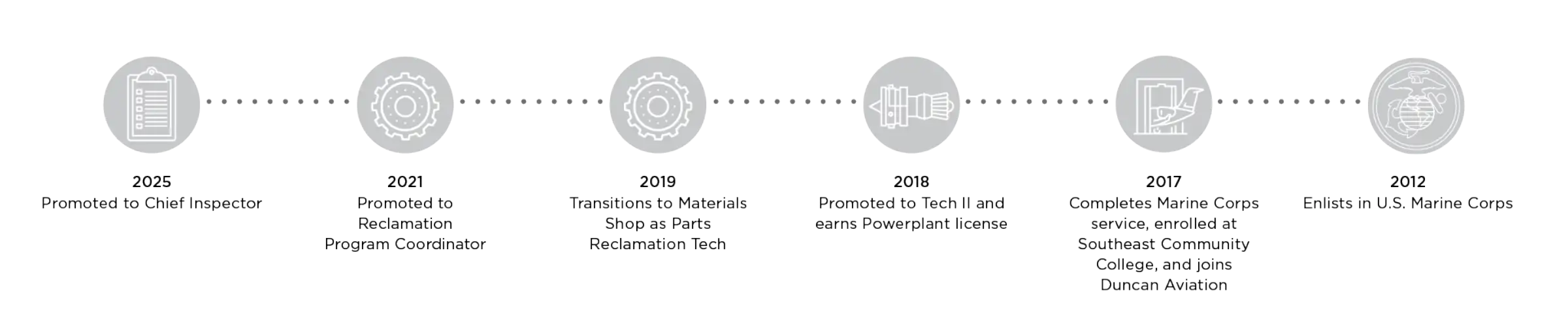
Chelsea enlisted in 2012, and with no female training facilities yet at MCRD San Diego, California, she shipped out to Parris Island in South Carolina. After acing the ASVAB, she landed a five-year contract as a KC-130J Crew Chief—and that decision changed everything.
“I loved it. The KC-130J is a big transport aircraft, so instead of landing on ships during forward deployments, we stayed in hotels,” she laughs. “I sat behind the pilots as part of the air crew and was the in-flight systems expert. If something went wrong in the air, I handled it.”
Chelsea jokes that she was a jack-of-all-trades, but the reality of her role required technical depth. In flight, she served as the aircraft’s systems manager, monitoring fuel, hydraulics, electrical systems, environmental controls, and engine indications while troubleshooting issues that might arise, such as smoke and fumes or abnormal readings.
Away from station, she was the on-the-road mechanic, handling post-flight inspections, servicing, and repairs. If a complex problem surfaced, she coordinated with experts back at home station, who would walk her through the corrective steps to ensure the aircraft was returned to service safely.
“It taught me to stay calm, troubleshoot effectively, and put in the right people when the mission called for it,” she says.
While stationed at MCAS Miramar, she volunteered to transfer overseas and soon received orders to MCAS Iwakuni, Japan, where she spent the next two years flying missions throughout eastern Asia—the Philippines, Cambodia, Thailand, Nepal, and even Australia.
It was during her time in Japan that Nepal was struck by the devastating 2015 earthquake. Chelsea was part of Operation Sahayogi Haat (Helping Hands), the Marine Corps–led humanitarian operation that delivered food, shelter, and medical supplies to remote, hard-hit regions.
She also worked missions to Hawaii and the Marshall Islands, including the tiny, breathtaking Wake Island.
“My favorite place was Wake Island—absolutely in the middle of nowhere,” she says. “Fewer than 100 people lived there, and at night, when the lights went out, you could see the entire universe. It felt like my own private vacation spot.”
When her enlistment ended in 2017, Chelsea knew she wasn’t moving back to Connecticut. She had friends working at Duncan Aviation, so she headed to Lincoln and enrolled at Southeast Community College, and began with an Early Childhood Education major (later switching to Aeronautical Science at Embry Riddle Aeronautical University). She also picked up what she expected to be a simple role at the Front Desk to fill her free time between classes.
But Duncan Aviation had other plans.
Manager of FBO Services Troy Hyberger noticed her love of solving problems and began mentoring her. Soon after, James Prater, former Manager of the Engine Shop, stopped by with a suggestion: With your background and experience, why don’t you come work on engines?
She applied—and it felt like coming home. “I loved being back in maintenance. Turning wrenches again just felt right.”
By 2018, Chelsea had moved from Tech I to Tech II, working closely with small, tight-knit engine teams where she soaked up knowledge from seasoned experts. Duncan Aviation also sent her to Baker’s School of Aeronautics, where she earned her Powerplant license.
In 2019, she transitioned into the Materials Shop as a Parts Reclamation Tech, working deeply with the Engine Shop while dissecting manuals, Service Bulletins, and every inch of the 731 engines. She helped revive a dormant program that had been originally pioneered by the late Leo Sawatzki. She rebuilt processes and wrote the program manual that now lives on the D3.
The work brought her into close collaboration with Enterprise QA Manager Mike Mertens, then Chief Inspector Paul Lewandowski, and RTS Team Lead Mark McKain—all open books, she says, who generously guided her through complex technical and regulatory territory.
By 2021, she’d been promoted to Reclamation Program Coordinator, shifting toward engine acquisition and both internal and external parts sales, while continuing to manage project flow. Last year, she became Engine Acquisitions & Sales Manager, partnering closely with Enterprise Material Manager Paul Oneth, Purchasing Supervisor Anthony Baxa, and VP of Engine Operations Doug Alleman to evaluate engine purchases, analyze profitability, and prepare contracts.
Then came the opportunity she’d quietly been preparing for.
After Paul transitioned to Government & Special Programs, Chelsea applied for his old position. On October 6, 2025, she officially became Chief Inspector.
She credits mentors like Troy, Paul, and Doug for shaping who she is and where she is today.
“None of them ever just gave me answers,” she says. “They’d ask questions that pushed me to think it through myself. That changed how I approached problems, and it’s the kind of mentor I’m working to become.”
Chelsea’s mission as Chief Inspector is big—and bold. She wants to change the perception that quality, procedures, and inspections are roadblocks.
“My goal is to empower both new and tenured team members and help everyone see how much expertise we have here,” she says. “Regulatory compliance shouldn’t feel restrictive—it should feel like a shared effort to reach the highest standards.”
Outside of work, Chelsea insists she’s pretty boring, though her life suggests otherwise.
Her 3-year-old son, Kieran Joseph, KJ, keeps her on the move. “We go to zoos, we stop at random parks he spots from the car…he pretty much runs my schedule,” she laughs.
Their household also includes three dogs: a Chocolate Lab/Aussie mix, an Australian Shepherd, and a Border Collie/Corgi mix. “He looks like a Border Collie with the butt of a Corgi,” she jokes.
She unwinds with puzzles and podcasts—history, science, scandals, and the occasional true crime—and plays golf exactly once a year: at the Duncan Aviation United Way scramble; though, she hopes to make it a weekly habit again.
Looking back, Chelsea feels incredibly grateful for the opportunities she’s had at Duncan Aviation.
“People have taken chances on me when I wasn’t necessarily qualified on paper, but they saw my potential and trusted I’d rise to the occasion,” she says. “I’ve grown personally and professionally, and I’m surrounded by people who want to share what they know and love. That makes me want to be that kind of person—to support others and add value.”
She encourages anyone interested—even those without aviation experience—to apply. “What I tell people is: Even if you don’t think you’re qualified, apply anyway. They can always say no. But they might say yes.”
She laughs as she remembers talking with Paul Lewandowski years earlier, and saying, I want your job.
“I didn’t expect it to happen so soon, and I definitely couldn’t have done it without Paul’s guidance and support. He’s taught me so much, and while he left massive shoes to fill, I’m committed to carrying forward the level of excellence he modeled in this role.”