
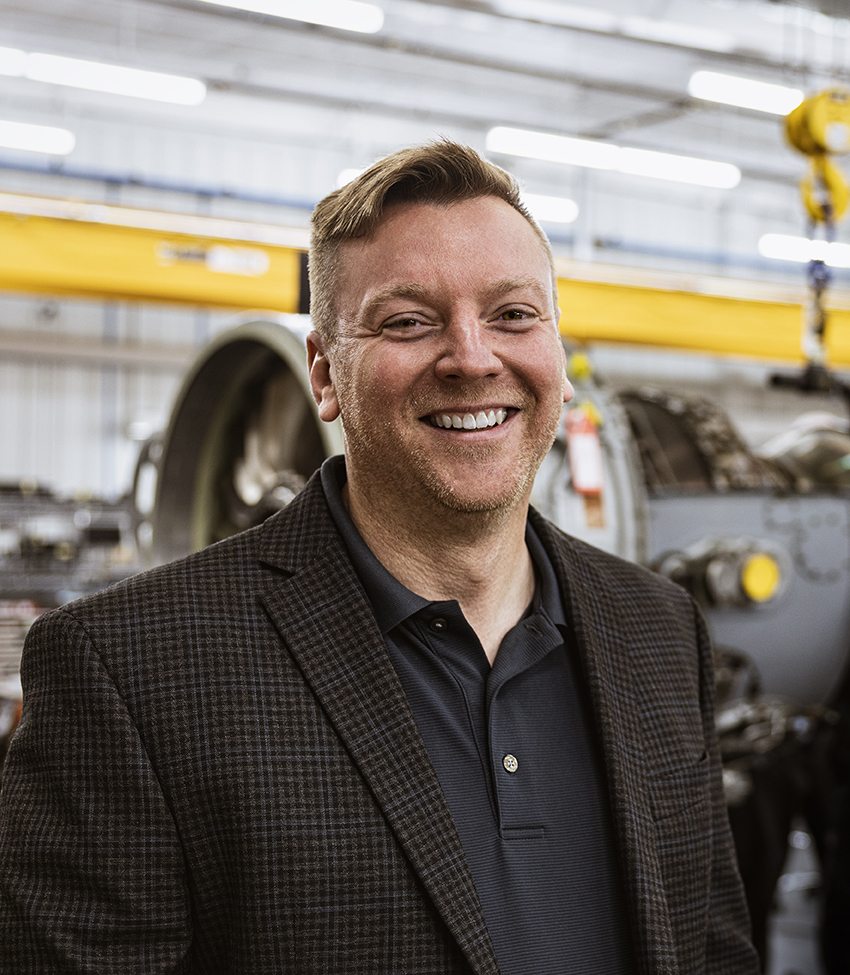
Scott Stoki’s career at Duncan Aviation reflects a steady progression built on curiosity, technical expertise, and a willingness to take on new challenges. Since joining the company in 2005 as an Engine Line Technician, Scott has advanced through nearly every level of engine maintenance and leadership—each step adding a new layer to his understanding of the business.
Now serving as Vice President of Engine Operations, Scott leads with a perspective shaped by hands-on experience, cross-departmental knowledge, and a deep connection to the people and processes that drive Duncan Aviation’s success.
Scott grew up in Lincoln, Nebraska, where his interest in mechanics started early. He was naturally drawn to understanding how things worked—especially cars—and spent time taking them apart and rebuilding them.
His first exposure to Duncan Aviation came through school tours at a young age.
“I remember thinking, ‘This is awesome,’” Scott says. “Even then, it exceeded anything I had imagined.”
Encouraged by his father, a family friend who was an A&P mechanic, and former Duncan Aviation team member Dale Green, Scott pursued his Airframe & Powerplant (A&P) license. After attending tech school in Sidney, Nebraska, he gained early experience in aviation through paint work in Lincoln and overnight maintenance on Beech 1900Ds for a commuter airline.
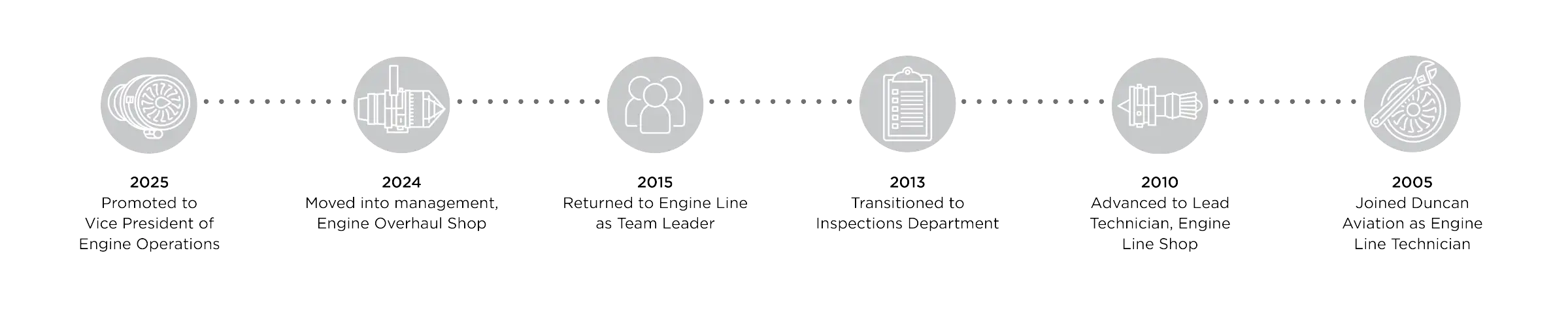
Scott joined Duncan Aviation in January 2005 as an Engine Line Technician I, intentionally choosing engines as his focus area.
In this role, he built a strong technical foundation—removing and installing engines, troubleshooting discrepancies, running tests, and returning aircraft to service. As he progressed to Technician II and III, his responsibilities expanded to more complex diagnostics and mentoring newer technicians, marking his first shift from individual contributor to informal leader.
By 2010, Scott advanced to Lead Technician in the Engine Line Shop, a transition that formally introduced leadership responsibilities. In addition to technical work, he was now coordinating teams, managing workflow, and ensuring quality and efficiency across projects.
In 2013, Scott made a pivotal move to the Inspections Department as an RTS II. This transition broadened his perspective beyond engines, giving him insight into the full scope of aircraft maintenance, compliance, and quality assurance processes. It marked a key shift from specialized technical work to a more holistic understanding of operations.
Two years later, in 2015, Scott returned to the Engine Line Shop as a Team Leader—this time combining his deep technical background with a broader operational view. In this role, he played a critical part in aligning day-to-day execution with larger organizational goals, bridging the gap between technicians and leadership.
In 2019, Scott moved into a management role within the Engine Overhaul Shop, representing another significant step in his career progression. This transition expanded his responsibilities from leading teams to managing operations—overseeing resources, driving efficiency, and contributing to long-term planning.
In 2024, he took on the challenge of managing the new Pratt & Whitney Overhaul Shop, helping bring the operation online. This role required not only technical expertise, but also strategic thinking—building processes, supporting new capabilities, and positioning Duncan Aviation for continued growth in engine services.
Each of these transitions—from technician to lead, from inspections back to engines, and from team leadership into management—added new dimensions to Scott’s experience and prepared him for executive leadership.
In his current role as Vice President of Engine Operations, Scott builds on that progression to lead Duncan Aviation’s growing engine services business.
Following five years of rapid growth, his priorities include expanding engine maintenance capabilities across platforms, reducing turn-times by optimizing workflows within the 36,000-square-foot Designated Overhaul Facility (DOF), and enhancing parts sourcing and in-house repair capabilities through collaboration with Duncan Manufacturing Solutions (DMS).
He also supports the development of new programs, including Pratt & Whitney and Honeywell APU overhaul capabilities, along with continued investment in facilities, test cells, and training.
“Scott has an unparalleled blend of technical acumen and strategic foresight,” says Duncan Aviation President Mike Minchow. “His leadership will be pivotal as we continue to expand our capabilities and deliver the exceptional service our customers have come to expect.”
Scott succeeds Doug Alleman, who is retiring after a 38-year career, ensuring continuity for customers while positioning the organization for the future.
While Scott’s career progression is defined by new roles and responsibilities, he credits Duncan Aviation’s culture and people as the driving force behind his growth.
“The culture, the relationships, and the opportunities to solve problems are what kept me here,” he says. “I’ve grown not just in what I do, but in how I work with others.”
Through leadership training programs like Resilient Leadership, Crucial Conversations, and Emergenetics, Scott has developed a more thoughtful and intentional leadership style—learning to step back, evaluate situations from multiple perspectives, and communicate more effectively.
Mentorship has also played a key role, from early technical guidance to leadership development under Doug Alleman.
Scott encourages those starting their careers to actively seek opportunities and build connections.
“Get involved. Work across departments, build relationships, and make your ideas known,” he says. “Growth comes from putting yourself in positions where people can see your effort and your potential.”
He is committed to creating those same opportunities for others, helping team members grow their careers while strengthening Duncan Aviation’s future.
Outside of work, Scott continues to pursue his passion for mechanics through restoring classic cars, specializing in body work, engine rebuilding, and carburetors.
He is also an accomplished racer at the Bonneville Salt Flats, where he built the engine for his 1985 Pontiac Firebird, reaching a personal best speed of 241 MPH. You can watch Scott talk more about this accomplishment in episode 3 of Duncan Aviation TV.
At home, he enjoys time with his wife, Kristina, their dogs Thea and Tuvo, and cats Scooter and KitKat.